• Call Support 86-0596-2628755

10 Bookcase Buying Tips for Global Buyers

Buying a Bookcase for international use requires more than choosing an attractive finish. Global buyers must consider dimensions, materials, safety, packaging, and long-term performance. A shelf that fits a showroom may fail in a narrow apartment or during overseas transport.

This guide presents ten practical buying tips for comparing Bookcase options with greater confidence. Measure the wall, doorway, elevator, and final installation area before ordering. Check shelf load ratings, frame stability, edge finishing, and the quality of connectors. Solid wood can offer durability, while engineered panels may reduce cost and shipping weight. However, material labels alone do not guarantee reliable construction.

Look closely at certifications, supplier documentation, warranty terms, and replacement-part support. Requirements can differ between markets, so buyers should verify applicable safety and labeling rules locally. Ask for carton dimensions, assembly instructions, moisture protection, and realistic delivery timelines. Photographs help, but they can hide uneven panels or weak rear supports. That happens.

A careful buyer should also review sustainability claims and confirm whether recycled content is documented. Price matters, yet a low initial quote may exclude duties, damaged-item risk, or installation costs. I have seen buyers focus heavily on appearance and overlook a simple question: how will the Bookcase reach the room? These tips cannot remove every purchasing uncertainty, but they can make comparisons clearer, decisions more defensible, and costly surprises less likely.
10 Bookcase Buying Tips for Global Buyers

Define Your Storage Needs and Bookcase Purpose

Before choosing a bookcase, define what it must store. Measure your books, folders, baskets, and display objects. Record the tallest item, not just the average one. A shelf that fits novels may fail with art books or storage boxes. Leave a small clearance above each group. It makes rearranging easier later.

Decide where the bookcase will work hardest. A study may need deep shelves for files, while a living room may need shallow shelves for books and decoration. In a child’s room, rounded edges and stable construction matter more than visual style. Check the wall type before planning an anti-tip connection. Drywall, brick, and concrete require different fixing methods. This detail is easy to overlook.

Think about weight over time. Paper is heavy, especially in a full lower shelf. Review the stated load capacity and support spacing. If shelves can adjust, test the lowest practical position first. It reduces wasted vertical space. For humid regions, inspect the material’s moisture resistance and keep the unit away from direct water. In dry climates, wood-based panels may still change slightly with seasonal movement.

I once planned storage around a neat display, then discovered that frequently used files were too high. That mistake made the room less convenient. Measure your daily reach. Leave open space for growth, too. Needs change. A bookcase should support real routines, not only a showroom arrangement.


Compare Materials, Construction Quality, and Load Capacity

10 Bookcase Buying Tips for Global Buyers

When comparing bookcases, start with the material, not the finish. Solid wood offers strength and repairability, but it can expand in humid rooms. Engineered wood is often more stable and affordable. Check the panel thickness and edge sealing carefully. Thin boards may sag under heavy books. Steel frames provide excellent support, although poor coatings can scratch or rust during transport.

Construction quality deserves a close inspection. Look for tight joints, reinforced corners, a firm back panel, and level-adjustment feet. Shelves should sit evenly without rocking. Adjustable shelves are useful, but their pins must fit securely. I once accepted a cabinet with attractive surfaces and weak joints. It looked fine in photographs. That was a mistake. Photos rarely show wobbling, uneven drilling, or fragile hardware.

Load capacity needs practical testing. A shelf rated for 30 kilograms may perform differently when weight is concentrated at the center. Ask whether the rating applies to each shelf or the entire unit. Consider the weight of large art books, storage boxes, and decorative objects. Leave some capacity unused. Also check the wall-fixing method, especially for tall furniture. International buyers should review packaging protection, assembly instructions, and local safety requirements. Small details matter. A lower-priced bookcase can become expensive after replacement parts, damaged panels, or difficult assembly.

10 Bookcase Buying Tips for Global Buyers

Compare Materials, Construction Quality, and Load Capacity

Representative planning values for an evenly distributed load on one shelf approximately 80 cm wide and 30 cm deep. Actual capacity depends on shelf thickness, span, support spacing, fasteners, wall anchoring, and manufacturer testing. Check the stated load rating before purchase, especially for heavy books or archive storage.

Choose the Right Size, Style, and Space-Saving Design

10 Bookcase Buying Tips for Global Buyers

Choose the right size before admiring the finish. Measure wall width, ceiling height, doorways, and elevator space. Leave at least 70 centimeters for comfortable walking clearance. Check shelf depth too; 25 to 30 centimeters suits most books without wasting floor area. UN-Habitat’s World Cities Report notes that 56% of people lived in urban areas in 2021, with the share expected to reach 68% by 2050. Compact living is becoming normal.

Match the bookcase with the room’s visual weight. Light colors and open backs can make a narrow room feel less crowded. Tall units use vertical space, but they need secure anchoring. Adjustable shelves support different book heights and reduce awkward gaps. Look for stable joints, smooth edges, and load information from the manufacturer. Statista Market Insights estimated global furniture revenue at about US$766 billion in 2024, showing how broad this market has become, but price still does not guarantee durability.

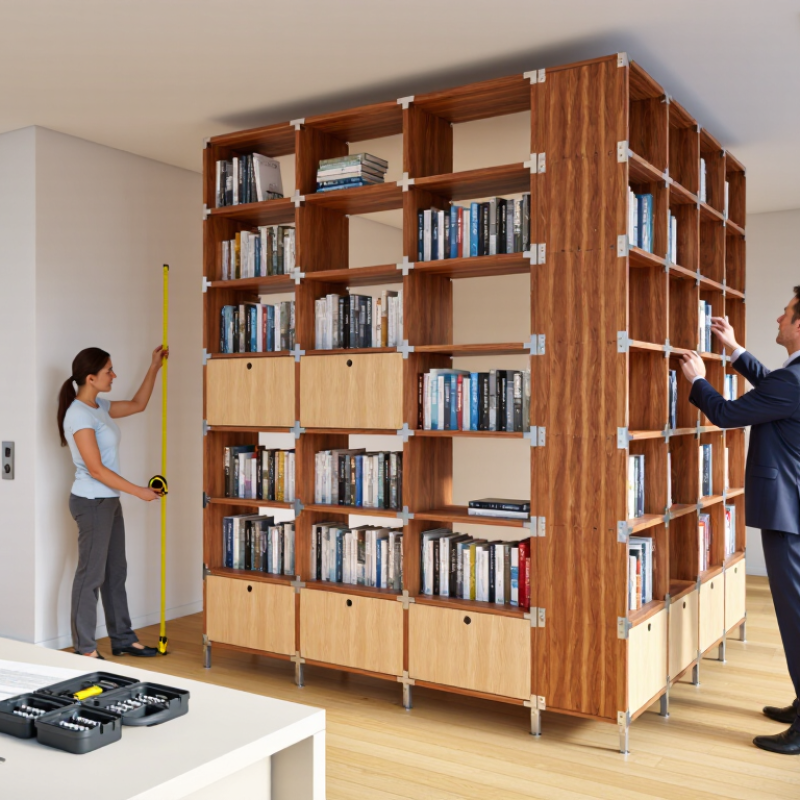
Choose modular, corner, ladder-style, or wall-mounted designs when floor space is limited. Consider cable openings if the unit will hold lamps or speakers. Confirm material certifications, especially for engineered wood and indoor air quality. I once underestimated doorway width; delivery became the expensive part. Measure twice. Also check humidity, sunlight, and cleaning access. A beautiful bookcase that blocks a window, traps dust, or cannot enter the home is not a practical purchase.

10 Bookcase Buying Tips for Global Buyers - Choose the Right Size, Style, and Space-Saving Design

Buying Tip What to Measure or Check Useful Dimension or Benchmark Why It Matters Practical Buying Action
1Measure the available wall Record wall width, ceiling height, doorways, corridors, elevators, and stair turns before ordering. Keep at least 5–10 cm (2–4 in) of side clearance where installation or trim requires it. A bookcase may fit the wall but fail during delivery or assembly. Measure the narrowest access point and compare it with the packaged and assembled dimensions.
2Select suitable shelf depth Match shelf depth to the largest books, binders, décor, or storage boxes. Approximately 20–25 cm (8–10 in) suits many standard books; 30–40 cm (12–16 in) suits larger books and display items. Excess depth wastes floor space, while insufficient depth creates overhang and instability. Measure your largest items and add a small allowance rather than choosing depth by appearance alone.
3Plan shelf spacing Consider paperbacks, hardcovers, folders, albums, and decorative objects. Adjustable shelves are most flexible; a useful general range is 25–35 cm (10–14 in) between shelves. Correct spacing reduces unused vertical space and prevents tall items from being forced sideways. Choose adjustable shelves or a mixed layout with at least one taller compartment.
4Match height to the room Check ceiling height, lighting, ventilation, windows, and nearby furniture. Leave a visible gap below the ceiling unless the unit is specifically designed as a fitted, floor-to-ceiling installation. A small clearance improves visual balance and allows for uneven floors or ceilings. For tall units, verify whether the product can be safely assembled upright and secured to the wall.
5Use vertical space carefully Evaluate whether a tall unit or several low units better suit the room and household. Low bookcases are generally easier to access; tall bookcases provide more storage per unit of floor area. Vertical storage saves floor space but can increase tipping risk and make upper shelves harder to reach. Reserve upper shelves for lightweight or infrequently used items and keep frequently used books at a comfortable height.
6Consider a space-saving design Look for corner, ladder-style, modular, stackable, or wall-mounted configurations. Corner units use otherwise difficult space; wall-mounted units require a suitable structural fixing point. The right configuration can increase storage without blocking walkways or reducing usable floor area. For modular or stackable units, confirm that connectors and anti-tip hardware are included or compatible.
7Check load capacity Review the maximum load per shelf and the total load for the complete unit. Never exceed the manufacturer’s stated capacity; distribute heavy books across lower shelves. Books are dense and can create concentrated loads that cause shelf bending or joint failure. Estimate the weight of your collection and choose reinforced shelves with limited unsupported spans.
8Prioritize stability and safety Inspect the base, back panel, leg levelers, wall anchors, and anti-tip provisions. Wall anchoring is especially important for tall, narrow, modular, or freestanding units. Proper anchoring reduces the risk of tipping caused by uneven floors, movement, or climbing. Use fixing hardware suitable for the wall type and follow the installation instructions precisely.
9Choose materials for the environment Assess humidity, temperature changes, direct sunlight, and cleaning requirements. Solid wood, engineered wood, metal, and glass have different moisture, scratch, and weight characteristics. Material selection affects durability, appearance, maintenance, and long-term shelf performance. For humid areas, confirm moisture resistance and keep the unit slightly away from damp walls.
10Verify international delivery details Check measurement units, assembly instructions, packaging, customs documentation, and replacement parts. Confirm dimensions in both centimetres/metres and inches/feet when comparing international listings. Unit conversions and delivery constraints can lead to incorrect orders or unexpected installation costs. Request packaged dimensions, gross weight, assembly time, warranty terms, and installation requirements before purchase.

Measurement note: Dimensions are practical planning ranges rather than universal specifications. Always confirm the product’s official dimensions, shelf-load rating, assembly requirements, and safety instructions before purchase.

Check Safety Standards, Assembly, and Maintenance Requirements

10 Bookcase Buying Tips for Global Buyers

Check Safety Standards, Assembly, and Maintenance Requirements

A bookcase can look sturdy in a product photo, yet stability depends on more than appearance. Global buyers should check local safety requirements before ordering.

Ask for test reports, load ratings, material information, and anti-tip details. Requirements can differ between countries, especially for children’s furniture and tall units. Confirm that the listed standard applies to your destination.

Assembly instructions deserve close attention. Clear diagrams, numbered parts, and correctly sized hardware reduce mistakes.

Check whether wall anchors suit your wall type, such as concrete, brick, or drywall. Some sellers provide unsuitable anchors for certain homes. That small detail matters.

I once assumed a heavy bookcase needed no wall fixing, but that assumption was wrong. The unit shifted when books were loaded unevenly.

Maintenance needs practical planning. Place the bookcase on a level surface and leave space from damp walls. Use a slightly dry cloth for dust, and avoid soaking unfinished surfaces.

Recheck screws after several weeks, especially after moving the unit. Inspect shelves for bending, loose joints, or chipped edges.

Humid climates may require closer inspections. Very dry rooms can also affect some wood-based materials.

Keep heavier books on lower shelves, and avoid exceeding the stated capacity. Instructions may seem obvious, but rushed assembly remains a common weakness.

Evaluate Global Shipping, Costs, Warranty, and Seller Reliability

10 Bookcase Buying Tips for Global Buyers

Evaluate Global Shipping, Costs, Warranty, and Seller Reliability

A bookcase can look affordable until international delivery charges appear. Check the packed dimensions, weight, delivery zone, and estimated transit time before ordering. Ask whether the price includes customs duties, taxes, and residential delivery. These charges can change the real cost sharply. Measure doorways, stairwells, and elevator space at home. A box that fits a warehouse may not fit your hallway.

Inspect the seller’s packaging details. Reinforced corners, foam protection, and moisture-resistant wrapping matter during long journeys. Ask for photos of the packed unit if the product is large or fragile. My own cross-border purchase arrived with a damaged shelf because I trusted a vague packaging description. That mistake was mine. Confirm the process for reporting damage, including photo requirements and deadlines.

Read the warranty in full. It should state the coverage period, excluded parts, repair options, and who pays return shipping. A warranty without a practical service process offers limited comfort. Check the seller’s response time before paying. Send a specific question about assembly hardware or replacement panels. A clear reply shows useful support. Silence is information too. Review recent buyer feedback, especially comments about missing parts, refunds, and delivery communication. Save invoices, messages, and tracking records. They may become important when expectations and reality do not match.